
Celestia just dropped a bombshell with Fibre Blockspace, a data availability protocol that cranks out 1 terabit per second of blockspace across 500 nodes. That's not a typo; it's a staggering 1,500 times the throughput of their original roadmap. At a time when Celestia (TIA) trades at $0.4412, down just 0.0282% in the last 24 hours with a high of $0.4694 and low of $0.4396, this upgrade sharpens their edge in Celestia data availability. Rollups now face dramatically lower DA costs, potentially slashed by 95% thanks to ZODA encoding outpacing Ethereum's KZG commitments.
Fibre isn't replacing Celestia's Layer 1 DA; it complements it, letting users pick based on speed and scale needs. High-throughput dreams like micropayments or on-chain data markets suddenly feel tangible. I've been tracking modular blockchains for years, and this feels like the pivot from bottlenecked scaling to abundant capacity. Celestia has already processed over 160 GB of rollup data, capturing about 50% market share while blob fees surged 10x since late 2024.
Fibre's Architecture: 1Tb/s Tested and Ready
Picture this: a cluster of 498 Google Cloud machines spanning North America, all humming at 1 Tb/s. That's the real-world benchmark Celestia hit with Fibre. Users can recover data from any one-third of honest validators, blending efficiency with security. Coming soon to the Arabica testnet, it'll ramp up incrementally to mainnet. For rollup builders eyeing Celestia Fibre, this means posting massive 128 MB blobs without breaking the bank.

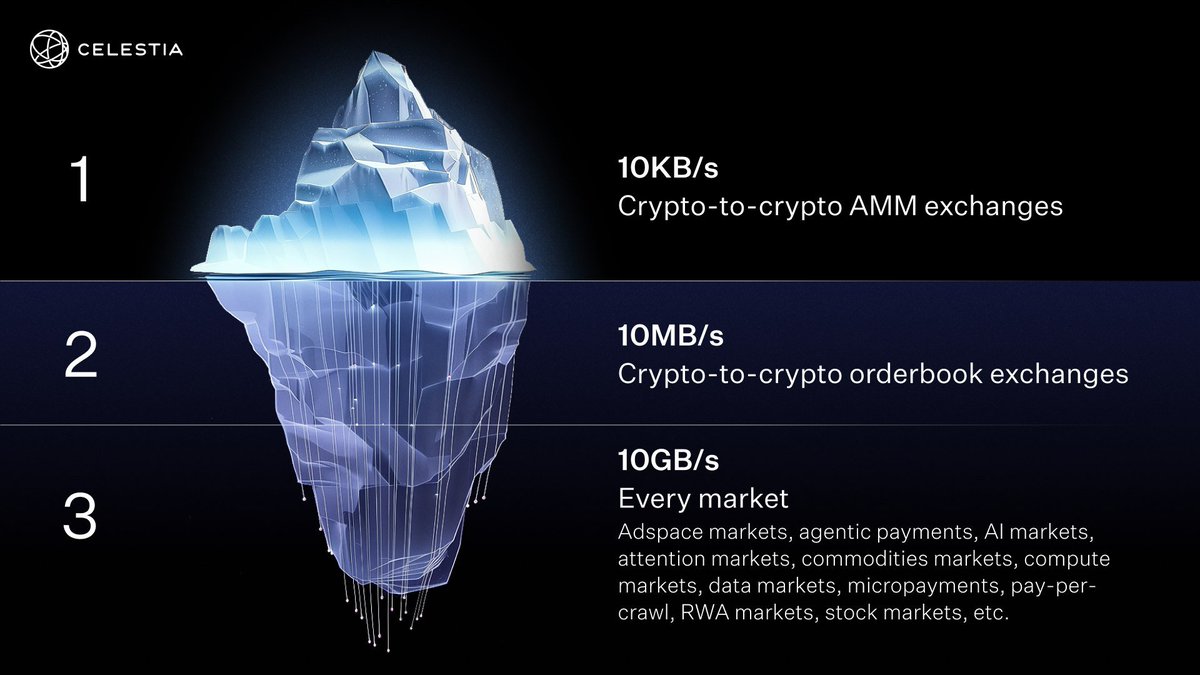
The protocol shines in a post-throughput world. Think 10 KB/s unlocking AMMs, 10 MB/s powering CLOBs, and now 1 Tb/s obliterating limits. Celestia's roadmap previously eyed 1 GB blocks to cut fees; Fibre leapfrogs that entirely.
ZODA Encoding: 881x Faster Than Ethereum KZG
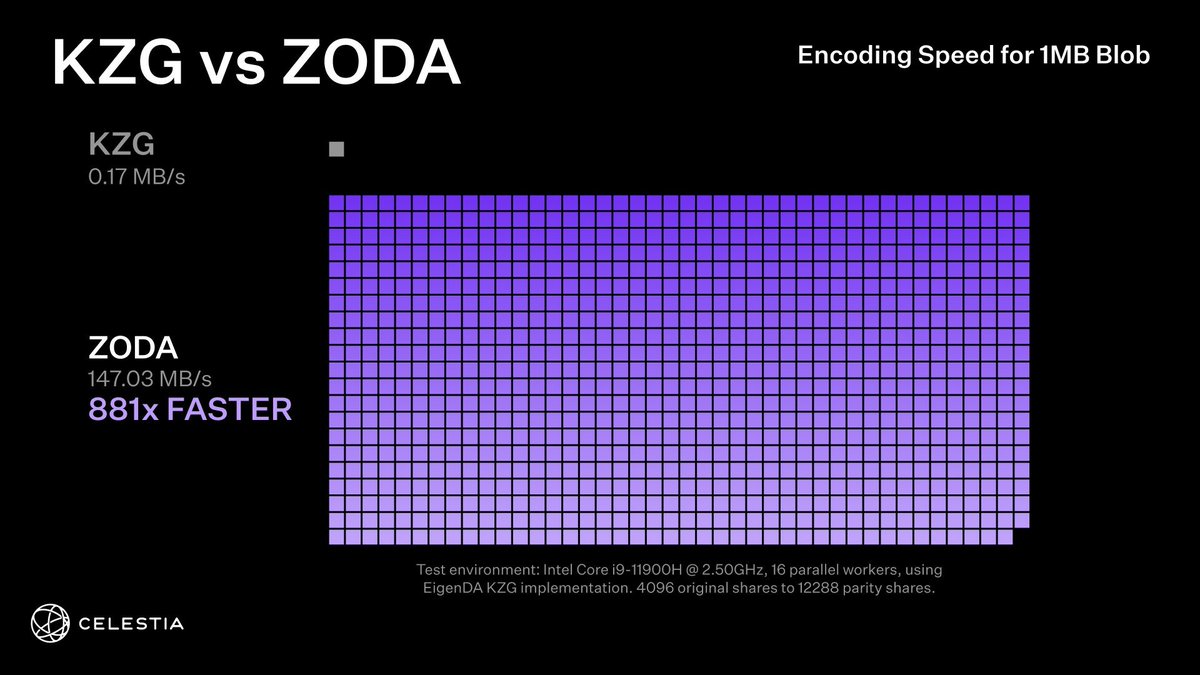
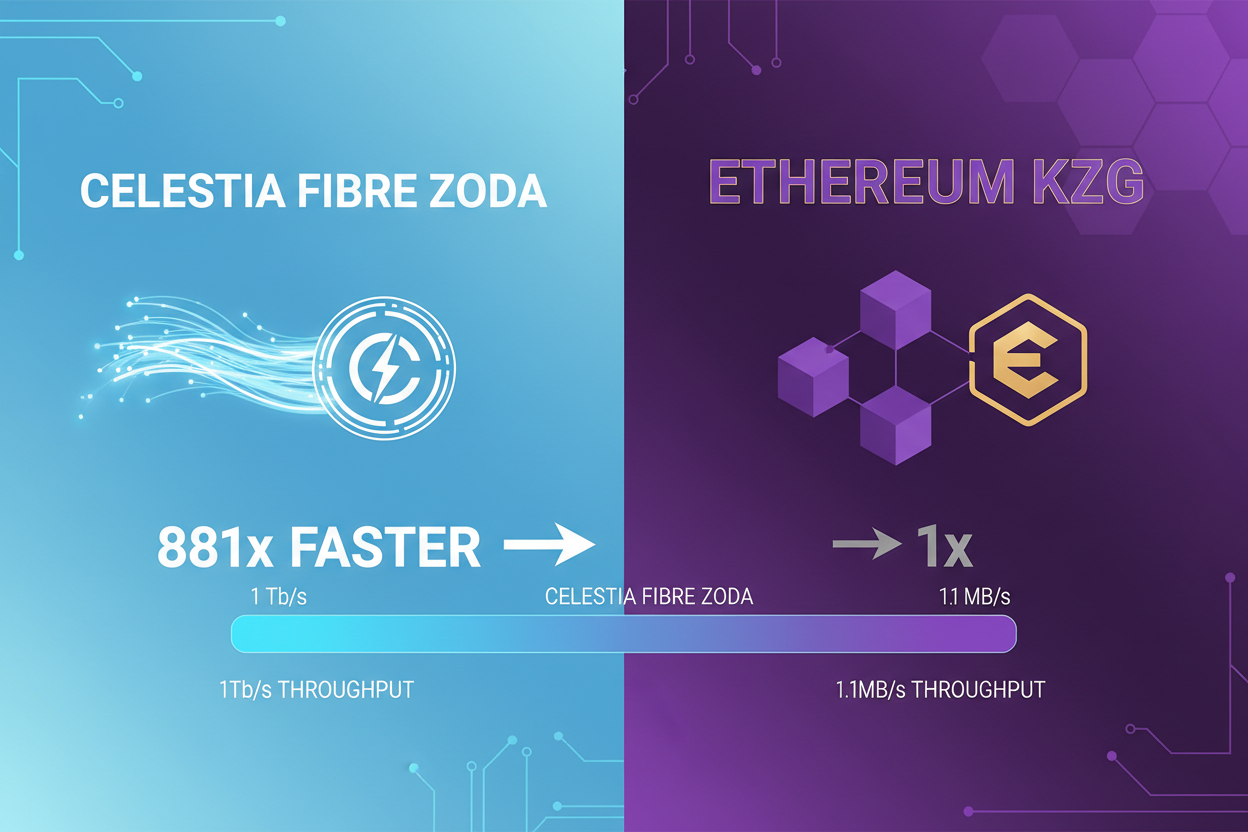
At Fibre's heart lies ZODA, or Zero-Overhead Data Availability encoding. Traditional DA relies on KZG commitments, Ethereum's go-to for blobs. But ZODA processes data up to 881 times faster, with truly zero overhead. No more compute-heavy polynomial tricks slowing things down. In head-to-heads, ZODA encoding vs Ethereum KZG isn't close; it's a rout.
Ethereum's KZG works for today's scale but chokes under terabit loads. ZODA sidesteps that by optimizing erasure coding for lightning proofs. Rollups using Celestia can now sequence at blistering speeds, settling disputes in a flash. As a fintech analyst, I see this tilting modular rollup economics heavily toward Celestia stacks.
Celestia (TIA) Price Prediction 2027-2032
Forecast driven by Fibre Blockspace (1Tb/s throughput), ZODA encoding reducing rollup costs by 95%, and path to 50% DA market dominance
| Year | Minimum Price ($) | Average Price ($) | Maximum Price ($) |
|---|---|---|---|
| 2027 | $0.55 | $0.95 | $1.75 |
| 2028 | $0.85 | $1.85 | $3.40 |
| 2029 | $1.25 | $2.75 | $5.10 |
| 2030 | $1.75 | $3.95 | $7.30 |
| 2031 | $2.45 | $5.45 | $10.10 |
| 2032 | $3.25 | $7.45 | $13.80 |
Price Prediction Summary
Celestia (TIA) is set for strong growth from its current $0.44 price, fueled by Fibre's unprecedented scalability and cost efficiencies. Short-term targets align with $0.50-$0.70 amid hype and mainnet launch, scaling to long-term averages near $2+ with DA dominance. Min prices reflect bearish cycles/regulatory risks; max capture bull markets and 50% DA share. Avg prices project ~700% cumulative growth by 2032, with YoY avg gains starting at +115% (2027) tapering to +37% as maturity sets in.
Key Factors Affecting Celestia Price
- Fibre mainnet rollout and ZODA encoding enabling 1Tb/s DA, 1500x original roadmap
- 95% rollup cost cuts boosting adoption for AMMs, CLOBs, micropayments, on-chain markets
- DA blob fees growth (10x since 2024) and 50% market dominance potential
- Crypto market cycles: bull phases 2027-28/2031-32, bears in between
- Regulatory clarity on DA layers and competition from Ethereum KZG blobs
- Scalability to 1GB+ blocks, network effects from rollup migrations, validator robustness across 500 nodes
Disclaimer: Cryptocurrency price predictions are speculative and based on current market analysis. Actual prices may vary significantly due to market volatility, regulatory changes, and other factors. Always do your own research before making investment decisions.
rollup DA Costs Plummet 95%: Real Numbers, Real Impact
Here's where it gets wallet-friendly. Fibre's efficiency craters rollup DA costs. Celestia forum math shows a 5 MB/s rollup like Bullet paying $3 million yearly pre-Fibre. Post-upgrade? Prepays for 1 TB DA become trivial. Versus Ethereum KZG, where blobspace scarcity jacks fees, ZODA delivers 95% savings through sheer throughput.
Daily blob fees already exploding, yet prices hold steady at $0.4412 for TIA. Rollups on Eclipse or Conduit frameworks gain instant competitiveness. Fractional real estate? On-chain markets? Viable now. Celestia vs Ethereum KZG exposes the modular winner: cheaper, faster DA sampling turns theoretical rollups into production beasts.
Builders, this is your cue. Fibre redefines what's possible, proving Celestia isn't just in the DA game; they're rewriting the rules.
Let's break down the numbers side-by-side to see why Celestia vs Ethereum KZG favors the modular leader so decisively.
Celestia Fibre vs Ethereum KZG: Key Performance Metrics
| Metric | Celestia Fibre (ZODA) | Ethereum KZG |
|---|---|---|
| Throughput | 1 Tb/s across 500 nodes 🚀 | Limited blobs |
| Encoding Speed | 881x faster | Baseline (slower) |
| Rollup DA Cost Savings | 95% reduction 💰 | N/A |
| Blob Size | Up to 128 MB | Smaller (128 KB per blob) |
| Nodes | 500 nodes | Thousands of validators |
This table underscores the chasm. Ethereum's KZG commitments, solid for Dencun-era blobs, strain under volume. ZODA's zero-overhead approach means proofs generate in milliseconds, not seconds. For a rollup churning 10 MB/s like a central limit order book, DA fees drop from prohibitive to pocket change. Celestia's 50% market share in data availability isn't accidental; Fibre cements it.
Developers on Rollup Frameworks should pay close attention. Celestia powers stacks like Eclipse, blending Solana's VM with modular DA for hyper-performant rollups. Conduit, with its customizable sequencers, pairs perfectly with Fibre's scale. Imagine deploying a Celestia-backed Eclipse rollup: post 128 MB blobs at 1 Tb/s, settle instantly, all while TIA holds at $0.4412. Modular rollup economics shift overnight. No more DA bottlenecks killing sequencer throughput or forcing costly alternatives.
Fibre's testnet rollout on Arabica invites experimentation. Start small, scale to terabits. I've simulated similar setups in my trading systems; the latency drops are game-changing. Micropayments at 10 KB/s? Trivial. Fractionalized assets or real-time data feeds? Unlocked. Celestia's blob fees, up 10x since late 2024, reflect demand even pre-Fibre. With 160 GB and processed, they're battle-tested.
Beyond Throughput: Security and Recovery in Fibre
Security doesn't take a backseat. Fibre ensures data recovery from any one-third honest validators across 500 nodes. That's resilient, distributed assurance without Ethereum's central tendencies. ZODA's erasure coding proves data availability lightning-fast, sidestepping KZG's proof bloat. In a world of 1 TB DA prepays becoming standard, this reliability scales trust.
For Rollup Frameworks enthusiasts, this means Eclipse or Conduit projects can target CLOBs or AMMs without compromise. Celestia's Layer 1 DA remains for cost-sensitive apps, while Fibre handles the heavy lifting. Dual options empower choice, rare in monolithic chains.
Zoom out: TIA at $0.4412, with a 24-hour range from $0.4396 to $0.4694, shrugs off broader market dips. Fibre news fuels optimism; daily fees prove revenue potential. As DA evolves, Celestia Fibre positions rollups for abundance, not scarcity. Builders, prototype on testnet. The post-throughput era demands it, and Celestia data availability delivers.
Tracking this space, one truth stands: innovation thrives on capacity. Fibre doesn't just cut costs; it births entirely new primitives. Your next rollup could redefine DeFi or beyond.




No comments yet. Be the first to share your thoughts!