

Why upgrade to Rollup 4
Rollup 4 features works best as a sequence, not a scramble through settings. Do the minimum first: confirm compatibility, connect the core hardware, update only when needed, and test the result before adding optional features. That order keeps the task understandable and makes failures easier to isolate. After each step, pause long enough for the interface to finish syncing. Many setup problems are timing problems disguised as configuration problems. If the same step fails twice, record the exact error, restart the smallest affected piece, and retry before moving deeper.
The simplest way to use this section is to keep the setup small, verify each change, and record the stable configuration before adding optional accessories.
4 Rollup 4 features 2026: Upgrade your build pipeline
Rollup 4 introduces performance optimizations and configuration changes that require immediate attention for existing projects. Review the following four features to understand the necessary adjustments for your build pipeline and ensure a smooth upgrade path.
-
Native ESM support for faster parsing
Rollup 4 eliminates the legacy CommonJS adapter overhead by parsing ESM syntax natively. This shift reduces initial bundle times significantly, as the parser no longer needs to transpile module formats before analysis. Configure your input options to rely on standard ES modules, ensuring the build pipeline processes imports directly. This optimization is critical for large monorepos where parsing latency accumulates across hundreds of dependencies. -
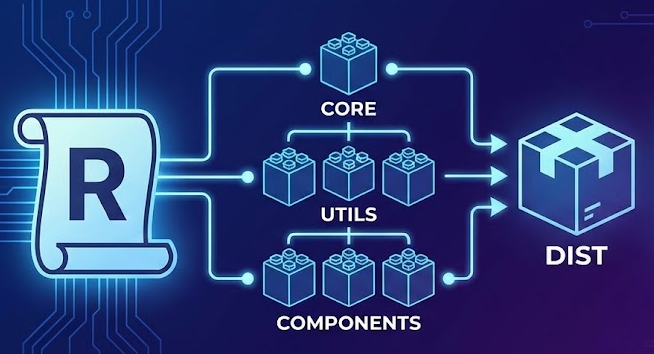
Improved tree-shaking for side-effect-free modules
The new analysis engine more aggressively identifies and removes unused exports from modules marked with sideEffects: false . Unlike previous versions, Rollup 4 now correctly handles complex namespace re-exports, preventing accidental inclusion of dead code. Update your package.json or rollup config to explicitly declare side-effect-free files. This precision reduces final bundle size without sacrificing functionality, ensuring only the code actually invoked in your application survives the build process. -

Built-in TypeScript declaration generation
Rollup 4 integrates declaration file generation directly into the bundling pipeline, removing the need for external plugins like rollup-plugin-dts . By leveraging the TypeScript compiler API internally, it produces accurate .d.ts files that reflect the bundled output structure. Enable this feature by setting the declaration option in your configuration. This streamlines library distribution, ensuring consumers receive type definitions that match the runtime code without requiring a separate build step or complex post-processing scripts. -
Enhanced sourcemap handling for debugging
Debugging is now more precise with Rollup 4’s improved sourcemap generation, which better maps minified code back to original source lines. The tool now supports inline sourcemaps for development builds and separate file generation for production, reducing payload size while maintaining traceability. Configure the sourcemap option to true or hidden based on your environment. This enhancement allows developers to step through original TypeScript or ES6 code in browser dev tools, significantly speeding up the identification and resolution of runtime errors.
Install native binaries
Rollup 4 shifts from a pure JavaScript implementation to one that includes native code. This change delivers faster build times for many platforms, but it introduces a new installation mechanism. The native binaries are now installed as an optional npm dependency. This means Rollup will automatically fetch and install the correct binary for your operating system and architecture during npm install, and remove it when you uninstall the package.
Step 1: Update your dependency
Start by updating Rollup to version 4 in your project. You can use npm, yarn, or pnpm to perform the upgrade. This step ensures you have the latest version which includes the new optional dependency structure.
npm install rollup@^4.0.0 --save-dev
Step 2: Verify native binary installation
After the update, check your node_modules directory. You should see a new folder named @rollup/ containing native binaries specific to your platform. These binaries are handled automatically by npm. If you encounter issues, ensure your npm version is up to date, as older versions may not handle optional dependencies correctly.
Step 3: Test your build
Run your build process to confirm everything works as expected. The native binaries will be used automatically if your platform is supported. If Rollup falls back to the JavaScript implementation, it will log a warning. This fallback is rare on modern systems but can happen on unsupported architectures.
Step 4: Handle unsupported platforms
If you are on an unsupported platform, Rollup will continue to work using the JavaScript implementation. However, you may see a warning message during installation. This is normal. The build will proceed, but it may be slower than on supported platforms. There is no additional configuration needed to force this behavior; it is automatic.
Fix plugin compatibility
Plugin API changes are the primary friction point when upgrading to Rollup 4. Many third-party plugins rely on deprecated hooks or internal structures that have been removed or altered in the new version. Before attempting a build, you must audit your dependency tree to ensure every plugin supports the updated interface.
After resolving these compatibility issues, your build pipeline should align with Rollup 4's performance improvements and stricter standards. If specific plugins remain incompatible, consider temporarily pinning your Rollup version to 3.x until the plugin maintainers release updates.
Optimize output configuration
Production builds demand stability. Rollup 4 improves how it handles ESM output and generates chunk hashes, reducing cache busting caused by minor code changes.
1. Set the output format
Configure the format option to ensure compatibility with your target environment. For modern browsers and Node.js, esm is the standard. This allows Rollup to preserve the module structure rather than bundling everything into a single script.
// rollup.config.js
export default {
  input: 'src/index.js',
  output: {
    dir: 'dist',
    format: 'esm',
    // other options...
  }
};
2. Enable hash stability
Rollup 4 includes improvements to chunk hash calculation. These updates make hashes more stable across builds, meaning unchanged files keep the same filename. This is critical for long-term caching strategies in production.
Ensure you are using the latest version of Rollup to benefit from these stability fixes. Without this, even minor refactors can change the hash of a chunk, invalidating user caches.
3. Configure external modules
Mark third-party libraries as external to keep your bundle small. Rollup will not bundle these modules; instead, it will import them from the environment at runtime.
export default {
  input: 'src/index.js',
  output: {
    dir: 'dist',
    format: 'esm',
  },
  external: ['react', 'react-dom']
};
4. Review the build output
Run your build and inspect the dist folder. Verify that the generated files match your expectations. Check that the chunk hashes remain consistent between builds when no source code changes occur.
Pre-deployment checklist
-
format is set to esm or cjs based on target
-
external array includes all third-party dependencies
-
Build output directory is clean before each run
-
Chunk hashes are stable across repeated builds
-
Source maps are disabled in production
Common rollup: what to check next
Rollup 4 simplifies configuration while tightening module resolution. Below are answers to frequent questions about plugins, external modules, and React integration.
No comments yet. Be the first to share your thoughts!