
4 Rollup 4 vs. Vite 6: Choosing the Right Bundler for 2026
Rollup 4 remains the center of gravity for build tooling, even as Vite 6 gains traction. Choose Rollup 4 when you need granular control over your bundle output. Select Vite 6 for faster development cycles and simpler configuration.
-
Rollup 4 plugin ecosystem maturity
Rollup 4 benefits from a deeply mature plugin ecosystem, offering battle-tested solutions for complex module transformations. This stability reduces integration friction for legacy codebases requiring precise control over the build pipeline. Developers rely on established plugins for features like aliasing and global analysis, ensuring predictable outcomes. The ecosystem’s longevity provides confidence that critical build steps remain robust and well-documented, minimizing unexpected runtime errors during deployment. -
Vite 6 HMR performance gains
Vite 6 significantly accelerates Hot Module Replacement by leveraging native ESM and optimized dependency pre-bundling. This results in near-instantaneous updates during development, drastically reducing feedback loops for frontend engineers. The improved architecture handles large dependency graphs more efficiently, maintaining smooth interactions even in complex applications. This speed advantage makes Vite 6 particularly attractive for teams prioritizing rapid iteration and immediate visual feedback. -

Rollup 4 tree shaking precision
Rollup 4 delivers superior tree-shaking precision, effectively eliminating unused code to produce leaner production bundles. Its static analysis capabilities accurately identify dead code paths, even in complex module structures, ensuring minimal payload sizes. This efficiency is crucial for performance-critical applications where bundle size directly impacts load times and bandwidth usage. The result is a highly optimized output that maintains functionality while stripping away unnecessary bloat. -
Vite 6 native TypeScript support
Vite 6 integrates native TypeScript support, eliminating the need for separate transpilation steps during development. This seamless integration accelerates the initial setup process and ensures type checking aligns with the development server’s fast restarts. Developers benefit from immediate feedback on type errors without additional configuration overhead. This streamlined approach simplifies the developer experience, allowing teams to focus on writing type-safe code rather than managing build tool complexity.
Core Differences
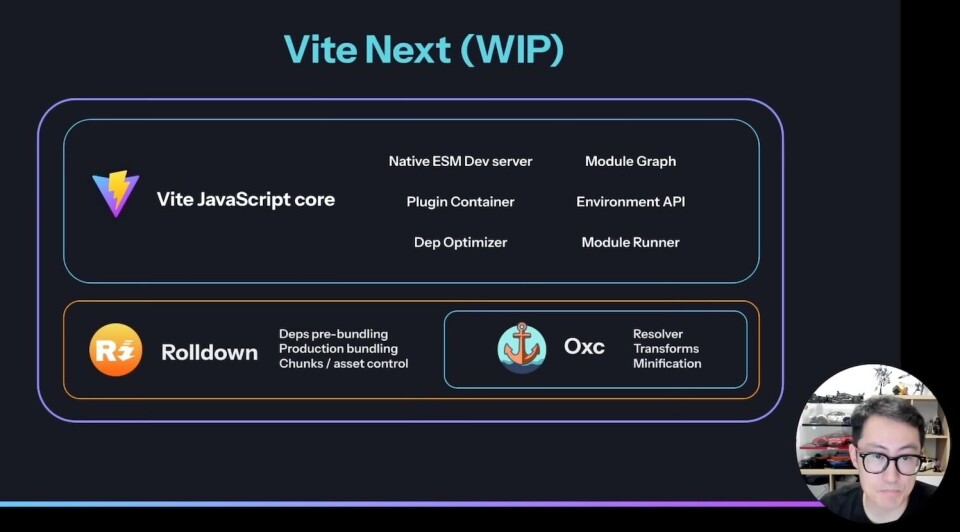
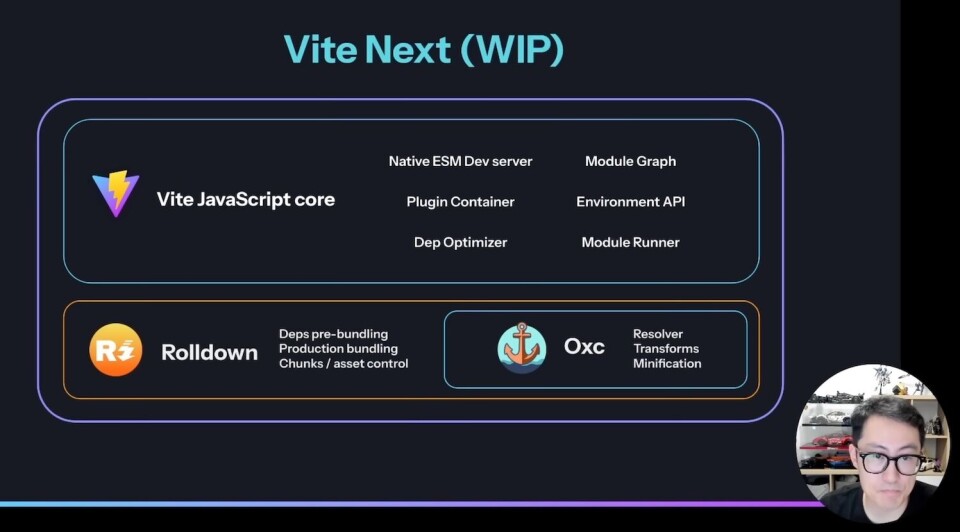
The confusion between Rollup 4 and Vite 6 stems from their close relationship. Vite 6 is primarily a development server that uses Rollup under the hood for production builds. This means Vite leverages Rollup’s bundling engine, but the two tools serve distinct phases of the development lifecycle.
Rollup 4 is a dedicated production bundler. It is designed to compile small pieces of code into larger, more complex artifacts like libraries or applications. Its strength lies in output format flexibility. It supports ES modules, CommonJS, UMD, SystemJS, and more, allowing you to bundle for the web and other platforms with precision.
Vite 6, on the other hand, prioritizes developer experience. It provides an instant local development server with Hot Module Replacement (HMR). While it uses Rollup for the final build step, Vite’s value is in the speed and simplicity of the development workflow, not the final bundle configuration.
When choosing, consider your end goal. If you are building a library or need granular control over output formats, Rollup 4 is the center of gravity. If you need a fast, modern development environment for an application, Vite 6 is the right choice, trusting its underlying Rollup integration for the production step.
When to Use Vite 6 Instead
Vite 6 shines when your project is a modern frontend application built on React, Vue, Svelte, or Solid. Unlike Rollup 4, which often requires complex configuration to handle these frameworks, Vite 6 works out of the box. It uses native ES modules in the browser during development, eliminating the need for a full bundle rebuild on every file change. This results in a development server that starts in milliseconds, not seconds.
If your team values rapid iteration, Vite 6 is the superior choice. The Hot Module Replacement (HMR) is tightly integrated with the framework-specific plugins, ensuring that code updates reflect instantly without full page reloads. This speed is critical for maintaining developer flow, especially in large applications where a single Rollup 4 rebuild might take significant time.
Vite 6 also simplifies configuration. While Rollup 4 offers granular control over the bundling process, it often demands a steep learning curve to set up correctly. Vite 6 provides sensible defaults that cover 90% of use cases. You can override specific settings when necessary, but you rarely need to write custom Rollup plugins for standard framework setups.
Quick Comparison
| Feature | Vite 6 | Rollup 4 |
|---|---|---|
| Dev Server Speed | Instant (ESM) | Slower (Bundle) |
| Configuration | Minimal | Complex |
| Framework Support | Built-in (React, Vue, etc.) | Plugin required |
| Bundle Output | Optimized for Web | Multi-format |
For library authors or projects targeting multiple environments (like Node.js or legacy browsers), Rollup 4 remains the center of gravity. But for modern web apps, Vite 6 offers a faster, simpler path to production.
Rollup 4 migration strategy
Moving from Rollup 3 to Rollup 4 requires updating dependencies and adjusting configuration to match new defaults. This migration is generally straightforward for most projects, but specific breaking changes in plugin compatibility and output formats need attention.
Run npm update rollup and update all related plugins. Check the Rollup 4 migration guide for a complete list of breaking changes. Ensure your plugins support Rollup 4 before upgrading the core bundler.
Rollup 4 changes default behaviors for output formats and external modules. Review your rollup.config.js to ensure plugins like @rollup/plugin-commonjs or @rollup/plugin-node-resolve are correctly configured for the new version. Remove any deprecated options that are no longer supported.
Run a full production build in your development environment. Watch for warnings about missing peer dependencies or deprecated API usage. Verify that your output files match the expected structure, especially if you are bundling libraries rather than applications.
Once local tests pass, update your continuous integration and deployment pipelines. Ensure that the build scripts use the updated Rollup version and that all environment variables remain consistent. Monitor the first few deployments for any runtime errors caused by subtle configuration shifts.
Frequently asked: what to check next
Is Rollup 4 better than Webpack?
For libraries and small-to-medium applications, Rollup 4 is often the superior choice. Unlike Webpack, which is a heavy-duty bundler designed for complex monolithic applications, Rollup focuses on creating smaller, more efficient bundles. Its native tree-shaking capabilities remove unused code more effectively than Webpack’s default configuration, resulting in faster load times and smaller file sizes for frontend libraries.
Is Rollup 4 better than Vite 6?
The choice depends on your project type. Vite 6 is an IDE-like development server that uses ES modules for instant startup, making it ideal for large-scale applications where developer experience and speed are priorities. Rollup 4 is the underlying bundler for production builds and is preferred when you need fine-grained control over the final output, such as specific plugin chains or legacy compatibility, without the overhead of a dev server.
Is Rollup 4 better than Parcel?
Parcel is a zero-configuration bundler that is great for quick prototyping, but it lacks the explicit configuration options that Rollup 4 provides. If you need to optimize bundle size, manage complex aliasing, or integrate with specific build tools, Rollup 4 offers the transparency and control that Parcel abstracts away. For production-ready projects, Rollup’s predictable output is generally more reliable.
What is Rollup 4?
Rollup 4 is the latest major release of the module bundler primarily used for building JavaScript libraries. It is designed to bundle code for the browser and Node.js, with a strong emphasis on tree-shaking to eliminate dead code. It is not a full-stack application server but rather a tool for packaging your source code into optimized, distributable chunks.
How much does it cost to use Rollup 4?
Rollup 4 is completely free and open-source software. There are no licensing fees, subscription costs, or hidden charges. You can use it in commercial projects without any financial obligation. The only "cost" is the time spent configuring plugins and understanding its API, which is well-documented and community-supported.
No comments yet. Be the first to share your thoughts!